Episodios

  • Learning with Candace Fleming: Award-Winning Nonfiction, Curiosity, and Big Questions from Jonestown to Rhinos
    Mar 18 2026

    In 2026, Candace Fleming did something no one else has ever done—she became the first author to receive both the Children’s Literature Legacy Award and the Margaret A. Edwards Award for Young Adult Lifetime Achievement in the same year, while also winning the YALSA Award for Excellence in Nonfiction for Death in the Jungle: Murder, Betrayal, and the Lost Dream of Jonestown. We celebrate that extraordinary moment, then go straight to what really matters to Candace: kids, questions, and story-rich nonfiction that invites readers to think.

    We talk about why she still shows up in classrooms as a “nonfiction cheerleader,” helping students see that great nonfiction starts with passion and curiosity, not a pile of facts. She shares how she encourages kids to move beyond “Google it” retrieval toward authentic research by starting with something they love, asking big, weird questions, and following those questions wherever they lead.

    The conversation explores the craft behind tackling complex, often heavy topics for young readers. Candace discusses Death in the Jungle and her current middle grade project on rhino poaching in South Africa, where wildlife forensics, economics, colonial history, and the story of one orphaned calf intersect. We reflect on nonfiction as an imaginative, deeply personal form of writing, and what it means to nurture original thinking and voice in an AI world.

    This episode offers a rare window into an unprecedented awards year and the curiosity-driven process behind some of today’s most compelling nonfiction for young readers.

    Chapters:

    • 01:42: What this triple recognition really means
    • 04:26: Writing across age groups & interests
    • 07:01: School visits, passion, & kid-chosen topics
    • 10:22: Retrieval vs research, big questions, & nonfiction as imaginative work
    • 12:17: Nonfiction in an age of AI: voice, perspective, & original thinking
    • 15:16: Rhino poaching: crime scenes, orphaned calves, & complex issues
    • 25:54: A “lighter” World War II family story
    • 27:27: Finding hope

    Learn More:

    • Visit Candace's website and follow her on Instagram.
    • Listen to Episode 18.
    • Check out Candace's books.
    • Learn more about CBCC & Wild Tomorrow.

    Support the show

    Share this episode

    If this conversation sparked wonder, gave you a helpful strategy, or offered a needed reminder of hope, please share it with a friend or colleague.

    Subscribe • Download • Review • Tell a friend

    Stay updated with our latest episodes and follow us on Instagram, LinkedIn, and the Adventures in Learning website. Don't forget to subscribe on Apple Podcasts, Spotify, or wherever you get your podcasts!

    *Disclosure: I am a Bookshop.org. affiliate.

    Más Menos
    30 m
  • Co-Creating STEM Storytime With Ashley Belote's Pirate Sheep, Muddy Bears & Big Bad Fred
    Mar 11 2026

    What if your next great STEM or STEAM lesson started with a pirate sheep, a muddy teddy bear, or a very confused Little Red who thinks a wolf is a cat? In this joyful springtime episode, author‑illustrator and former pre‑K teacher Ashley Belote joins Dr. Diane to share playful, practical ways to turn picture book read‑alouds into rich learning adventures for early childhood and elementary students. From sink‑and‑float challenges with Sheepwrecked, to slime chemistry in Valenslime and Frankenslime, to circuits, empathy, and seasonal change in Little Red and Big Bad Fred, you'll walk away with classroom‑ready ideas that blend laughter, literacy, and hands‑on STEM/STEAM exploration.

    Episode Chapters

    [00:00] Spring joy & Sheepwrecked adventures (mapping, sink/float, boat building)

    [04:31] Slime chemistry & growth mindset with Frankenslime/Valenslime

    [07:25] Don't Wash Winston: mud pies, compassion & engineering challenges

    [11:17] Little Red and Big Bad Fred

    Ashley's fractured fairy tale origin (playful doodling → wolf mistaken for cat), Little Red/Fred friendship arc, and why adults need unstructured play as much as kids do.

    [14:55] Energy stick circuits & connection demos the transformative power of friendship

    Hands-on science—turning insulators (wood spoons, paper towels) into conductors with foil/water mirrors how Little Red's friendship transforms conflicted Fred.

    [20:51] SEL application & seasonal science with Little Red and Big Bad Fred

    Kids apply circuit metaphor to relationships ("What insulates you from connection?"), plus Little Red's changing outfits/colors reveal seasons, time-of-day, visual literacy.

    [25:00] Make read alouds and read alikes your superpower for playful connections

    Call to Action

    Ready to make picture books your STEM superpower?

    • Explore Ashley Belote's picture books and reach out if you'd like Dr Diane and Ashley Belote to bring a picture book STEM workshop to your community

    Support the show

    Share this episode

    If this conversation sparked wonder, gave you a helpful strategy, or offered a needed reminder of hope, please share it with a friend or colleague.

    Subscribe • Download • Review • Tell a friend

    Stay updated with our latest episodes and follow us on Instagram, LinkedIn, and the Adventures in Learning website. Don't forget to subscribe on Apple Podcasts, Spotify, or wherever you get your podcasts!

    *Disclosure: I am a Bookshop.org. affiliate.

    Más Menos
    39 m
  • Traveling with Kindness: Alicia D. Williams on Joy, Courage, and the Power of Story
    Mar 4 2026

    What happens when you finally give that brave, younger version of yourself permission to come back out and play? In this episode, author and teaching artist Alicia D. Williams joins Dr. Diane to talk about solo travel, rediscovering joy, and seeking kindness around the globe—from Paris and Mexico to Ghana, Ireland, and Italy.

    Along the way, we celebrate Alicia’s beautiful new picture book, Nani and the Lion, and dive deep into the power of oral storytelling and read‑alouds to transform classrooms and kids’ lives. Alicia names what many early childhood educators feel: we rush children into writing before we’ve honored the building blocks of story. She shares why story should begin with talking, acting, drumming, and drawing—and how oral storytelling grows vocabulary, empathy, expression, and confidence.

    Looking for the perfect book for Read Across America or World Read Aloud Day? Look no further. Alicia has given us a lyrical original folktale that celebrates courage, rhythm, and the power of finding your voice.

    Episode Chapters

    • [01:07] Choosing bravery and joy through travel
    • [06:55] What happens when you ask, “Show me how kind the world is”?
    • [10:53] From invisible to seen -- finding community and connection
    • [14:08] Curiosity, conservation, and connection
    • [20:46] Nani and the Lion,
      • Alicia introduces Nani and the Lion,—an original folktale rooted in rhythm, drumming, repetition, and big, participatory read‑aloud moments that invite kids to march, roar, and join the story.
      • Alicia and Dr. Diane uncover the deeper theme: when you do the thing that brings you joy, you tame the “lions” that try to quiet you and help free others to be brave, too.
    • [28:55] Joyful read‑alouds and playful learning through STEM
    • [30:57] The power of oral storytelling
    • [33:40] From spoken story to writers’ workshop
    • [35:16] Sneak peek: Nani and the Monkey
    • [40:21] Choosing joy every day

    About Our Guest

    Alicia D. Williams is an award‑winning author, teaching artist, and global traveler. She is the author of Genesis Begins Again (a Coretta Scott King Honor Book) and the new picture book Nani and the Lion, Learn more on Episodes 29 and 77.

    Support the show

    Share this episode

    If this conversation sparked wonder, gave you a helpful strategy, or offered a needed reminder of hope, please share it with a friend or colleague.

    Subscribe • Download • Review • Tell a friend

    Stay updated with our latest episodes and follow us on Instagram, LinkedIn, and the Adventures in Learning website. Don't forget to subscribe on Apple Podcasts, Spotify, or wherever you get your podcasts!

    *Disclosure: I am a Bookshop.org. affiliate.

    Más Menos
    43 m
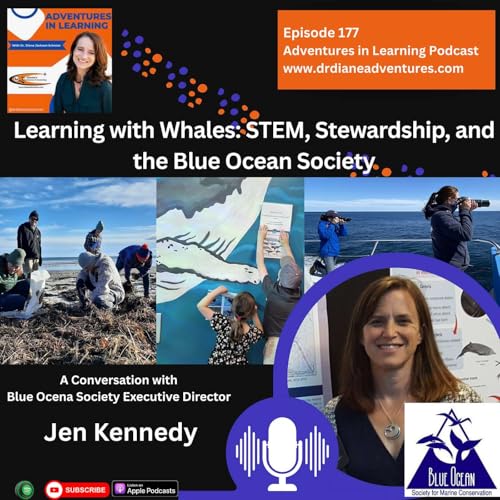
  • Learning with Whales: STEM, Stewardship, and the Blue Ocean Society
    Feb 25 2026

    What if your next STEM lesson started with a 65‑foot whale and a beach cleanup scavenger hunt?

    For 25 years, Blue Ocean Society has been quietly protecting whales and marine life right in our New England “backyard.” In this ocean-focused episode, Dr. Diane talks with co-founder and executive director Jen Kennedy about how long-term whale research, monthly beach cleanups, and joyful, hands-on education invite kids (and adults) to learn through play while caring for the Gulf of Maine.

    Jen shares how photo-ID lets them follow individual whales like Pinball and Little Spot over decades, and what threats like entanglement, vessel strikes, warming waters, and shifting prey mean for species such as the North Atlantic right whale. You’ll hear how Blue Ocean Society turns data collection into citizen science, trash into art, and curiosity into real-world STEM/STEAM experiences—through their inflatable fin whale, microplastics toolkits, marine-debris art projects, and kid-friendly “scavenger hunt” cleanups.

    If you love whales, teach STEM/STEAM, or want playful, hopeful ways to connect curiosity, conservation, and hands-on learning, this adventure is for you.

    Chapters:

    • 02:11 – From whale intern to co-founder: the Blue Ocean Society story
    • 04:00 – Falling in love with whales, photo-ID, Pinball & Little Spot
    • 06:29 – Threats to whales: entanglement, vessels & a warming Gulf of Maine
    • 08:20 – Learning through play: inflatable whales, school programs & touch tanks
    • 09:46 – Beach cleanups & turning data into action
    • 12:36 – Microplastics, foam fragments & upstream choices families can make
    • 15:32 – Citizen science: Marine Debris Tracker, microplastics toolkits & kids as scientists
    • 20:49 – Dream research cruises, hidden whales & what still excites Jen
    • 22:39 – Joy, resilience & favorite whale facts
    • 26:23 – How to donate, volunteer, adopt a whale & what gives Jen hope

    Links

    • Blue Ocean Society
    • Sign up for 2026 Blue Ocean Symposium
    • Follow on Instagram, Facebook, and LinkedIn

    Call to Action

    Ready to turn whale wonder into hands-on learning?

    • Choose one single-use item to swap for a reusable option this week and invite your learners to do the same.
    • Plan a “scavenger hunt” cleanup at your schoolyard, park, or local shoreline, and treat it like a STEM investigation.

    Support the show

    Share this episode

    If this conversation sparked wonder, gave you a helpful strategy, or offered a needed reminder of hope, please share it with a friend or colleague.

    Subscribe • Download • Review • Tell a friend

    Stay updated with our latest episodes and follow us on Instagram, LinkedIn, and the Adventures in Learning website. Don't forget to subscribe on Apple Podcasts, Spotify, or wherever you get your podcasts!

    *Disclosure: I am a Bookshop.org. affiliate.

    Más Menos
    29 m
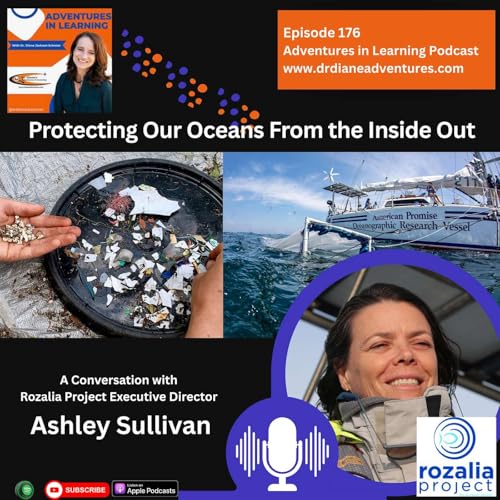
  • Protecting Our Oceans From the Inside Out with the Rozalia Project's Ashley Sullivan​
    Feb 18 2026

    Send a text

    If you’ve ever walked along a shoreline, spotted trash, and thought, “How did this get here, and what can I do about it?” -- this conversation is for you. Ashley Sullivan, Executive Director of the Rozalia Project for a Clean Ocean, joins me to unpack the very real problem of marine debris and microplastics, and to remind us that curiosity, community, and “lots of littles” can add up to big change.​

    We explore how getting kids and adults outside for hands-on cleanups builds empathy and sparks those powerful “aha” moments that lead to action. Ashley explains what microplastics and microfibers actually are, how they move from our homes into rivers, lakes, and the ocean, and why they’re now being found in wildlife, soils, air, and even our own bodies. You’ll also learn what it’s like to live and learn aboard a 60-foot research sailboat in the Gulf of Maine.​

    Ashley shares her winding career path from a childhood spent sailing in Florida to place-based environmental education and leading a marine conservation nonprofit. This episode is a rich resource for educators, caregivers, and young people imagining future STEM/STEAM and conservation careers, plus it serves up practical ideas and a generous dose of hope.​

    Chapters

    • 00:48 – Meet Ashley and the Rozalia Project
    • 02:30 – Marine debris 101: Where all this trash comes from
    • 02:54 – Starting with wonder: cleanups, empathy, and “aha” moments
    • 03:56 – Microplastics and microfibers made simple
    • 09:49 – The CORA Ball
    • 12:04 – American Promise: life and learning on a research sailboat
    • 18:25 – “Humans caused it, humans can fix it”
    • 22:06 – Place-based learning, philosophy, and the sea
    • 30:09 – Climate, storms, and why inland trash still reaches the ocean
    • 33:29 – What gives Ashley hope

    If this episode sparked curiosity, here are some next steps to take with your learners, families, or teams.

    Follow the Rozalia Project.​

    Support the show

    Share this episode

    If this conversation sparked wonder, gave you a helpful strategy, or offered a needed reminder of hope, please share it with a friend or colleague.

    Subscribe • Download • Review • Tell a friend

    Stay updated with our latest episodes and follow us on Instagram, LinkedIn, and the Adventures in Learning website. Don't forget to subscribe on Apple Podcasts, Spotify, or wherever you get your podcasts!

    *Disclosure: I am a Bookshop.org. affiliate.

    Más Menos
    35 m
  • Why Kids “Live in Books” -- James Ponti on City Spies: Europa and the Power of Middle Grade Readers
    Feb 10 2026

    Send a text

    What happens when a bestselling middle grade author joins you on World Read Aloud Day -- and opens the episode with a live read-aloud from his brand-new release?

    In this return conversation, James Ponti celebrates the book birthday of City Spies: Europa (Book 7!) and takes us behind the scenes of what it really takes to write page-turning mystery-adventure that kids don’t just read, they inhabit.

    We talk about the research rabbit holes that make a story feel real (including the world's most expensive cup of tea!), the craft of writing dialogue that flows, and why the read aloud shouldn’t stop in early elementary, especially for books that beg to be heard.

    You’ll also hear why James believes hope lives in the reader community itself: kids who show up dressed as characters, remember details from five books ago, and prove, again and again, that middle grade readers are powerful.

    Favorite Takeaways

    • Kids don’t just read books, they live in them.
    • The best middle grade is never “dumbed down.” Kids notice everything.
    • The read aloud is still one of the strongest tools we have for motivation, stamina, and connection.
    • Hope lives in communities of readers who show up, reread, and care deeply.

    Timestamps

    • 01:46 Special Read Aloud from the first chapter
    • 07:43 Behind-the-scenes research and inside jokes that add “richness” to the writing
    • 10:46 Middle grade growth: Sydney + Paris, insecurity, and learning to share what we carry
    • 12:57 Writing by ear: dialogue, flow, and reading drafts aloud 30+ times
    • 15:27 “Kids live in books”: fandom, rereads, deep questions, and catching mistakes
    • 28:35 Touring with author friends + building a wider reading life
    • 36:39 Hope: readers, community, and stories that model how people solve problems together
    • 40:36 What’s next: Sherlock Society: Art Attack (graffiti in Miami!)

    Connect + More

    • Learn more about James Ponti and check out his appearances on episodes 69, 98, and 119 of the Adventures in Learning podcast
    • Check out all of James Ponti's books
    • Sign up for Dr. Diane's 365 Day Picture Book Read Aloud calendar

    Support the show

    Share this episode

    If this conversation sparked wonder, gave you a helpful strategy, or offered a needed reminder of hope, please share it with a friend or colleague.

    Subscribe • Download • Review • Tell a friend

    Stay updated with our latest episodes and follow us on Instagram, LinkedIn, and the Adventures in Learning website. Don't forget to subscribe on Apple Podcasts, Spotify, or wherever you get your podcasts!

    *Disclosure: I am a Bookshop.org. affiliate.

    Más Menos
    41 m
  • Rewriting the Myths: Identity, Empathy, and Belonging in Middle Grade Fantasy with Tracy Wolff
    Feb 4 2026

    What happens when young readers are invited to question the stories they’ve always been told?

    In this episode of the Adventures in Learning podcast, Dr. Diane Jackson Schnoor welcomes bestselling author Tracy Wolff to celebrate the launch of her middle grade fantasy debut, The Aftermyth. Together they explore how mythology, storytelling, empathy, and student identity come together in powerful ways, and why middle grade fiction plays a critical role in helping young readers discover who they are and where they belong.

    From challenging patriarchal myth narratives to reimagining Aphrodite through compassion and friendship, this conversation highlights how fantasy literature can spark critical thinking, emotional growth, and a love of reading.

    Perfect for educators, librarians, families, literacy advocates, and middle grade readers.

    Episode Chapters

    • 01:21 Building a New Mythological World at Anaximander’s Academy
    • 03:12 Questioning History, Power, and Perspective in Stories
    • 07:13 Empathy, Friendship, and the Reimagining of Aphrodite
    • 10:12 Middle Grade Identity, Belonging, and Finding Your Voice
    • 13:29 Read-Alouds, Choice, and Building Reading Motivation
    • 18:32 Writing Middle Grade Fantasy and Keeping Kids Engaged
    • 19:49 What Brings Hope: Raising Compassionate Readers

    What You’ll Learn in This Episode

    • Why The Aftermyth challenges traditional Greek mythology narratives
    • How middle grade fantasy supports identity development and belonging
    • The importance of empathy and compassion in children’s literature
    • Why read-alouds should continue beyond early elementary grades
    • How student choice and format flexibility support reluctant readers
    • How storytelling builds motivation and reading stamina

    Featured Book

    📚 The Aftermyth by Tracy Wolff, available wherever books are sold.

    Check out The Aftermyth Reading Guide.

    Join Tracy Wolff on tour.

    Support the show

    Share this episode

    If this conversation sparked wonder, gave you a helpful strategy, or offered a needed reminder of hope, please share it with a friend or colleague.

    Subscribe • Download • Review • Tell a friend

    Stay updated with our latest episodes and follow us on Instagram, LinkedIn, and the Adventures in Learning website. Don't forget to subscribe on Apple Podcasts, Spotify, or wherever you get your podcasts!

    *Disclosure: I am a Bookshop.org. affiliate.

    Más Menos
    22 m
  • The Missing Piece in Reading Instruction: Motivation (with Behind the Book’s Anmarie Paul)
    Jan 28 2026
    What if the biggest gap in reading instruction isn’t phonics or fluency — but motivation?

    Dr. Diane Jackson Schnoor sits down with Anmarie Paul, Executive Director of Behind the Book, to explore how intrinsic motivation, belonging, student choice, and joyful literacy experiences help children become lifelong readers.

    Together, they unpack how Science of Reading practices and reading engagement strategies must work together because children don’t just need to learn how to read, they need to want to read.

    From expressive read-alouds to author visits, STEM-literacy integration, and identity-centered storytelling, this conversation offers practical insights for educators, librarians, parents, school leaders, and literacy advocates.

    Episode Chapters

    • 00:00 Motivation and Reading Instruction
    • 04:14 Read Alouds That Build Engagement and Fluency
    • 08:34 How Behind the Book Builds Reading Motivation
    • 15:30 Literacy, STEM, and Creative Learning
    • 18:40 Author Visits and Student Belonging
    • 24:55 Leadership in Literacy and Youth Development
    • 29:28 The Future of Reading: Engagement Meets Science of Reading

    What You’ll Learn in This Episode

    • Why intrinsic motivation is critical to reading success
    • How read alouds improve fluency, comprehension, and connection
    • What makes literacy programs truly engaging for students
    • How belonging and representation impact reading identity
    • Ways to combine Science of Reading + engagement-based practices
    • How literacy, STEM, creativity, and storytelling intersect
    • Strategies for building sustainable reading ecosystems

    🔗 Learn More & Get Involved

    • Behind the Book: https://www.behindthebook.org
    • Follow Behind the Book on Instagram, Facebook, and LinkedIn.
    • Download the Adventures in Learning 365 Day Picture Book Read Aloud Calendar

    Support the show

    Share this episode

    If this conversation sparked wonder, gave you a helpful strategy, or offered a needed reminder of hope, please share it with a friend or colleague.

    Subscribe • Download • Review • Tell a friend

    Stay updated with our latest episodes and follow us on Instagram, LinkedIn, and the Adventures in Learning website. Don't forget to subscribe on Apple Podcasts, Spotify, or wherever you get your podcasts!

    *Disclosure: I am a Bookshop.org. affiliate.

    Más Menos
    32 m