

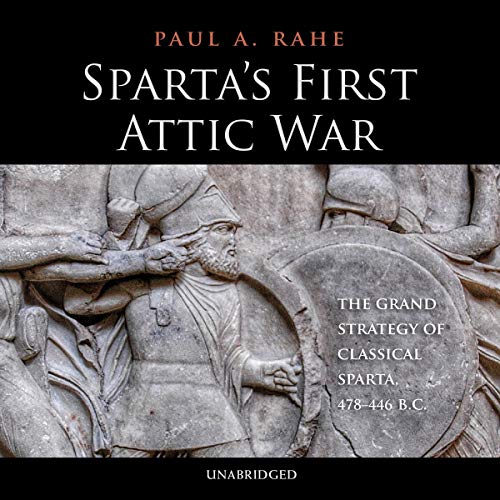
Sparta's First Attic War
The Grand Strategy of Classical Sparta, 478-446 BC
Failed to add items
Add to Cart failed.
Add to Wish List failed.
Remove from wishlist failed.
Adding to library failed
Follow podcast failed
Unfollow podcast failed
Get 3 months for $0.99/mo
 Prime members: New to Audible? Get 2 free audiobooks during trial.

Sparta's First Attic War
Buy for $13.97
-
Narrated by:
-
Paul A. Rahe
-
By:
-
Paul A. Rahe
A companion volume to The Spartan Regime and The Grand Strategy of Classical Sparta that explores the collapse of the Spartan-Athenian alliance
During the Persian Wars, Sparta and Athens worked in tandem to defeat what was, in terms of relative resources and power, the greatest empire in human history. For the decade and a half that followed, they continued their collaboration until a rift opened and an intense, strategic rivalry began. In a continuation of his series on ancient Sparta, noted historian Paul Rahe examines the grounds for their alliance, the reasons for its eventual collapse, and the first stage in an enduring conflict that would wreak havoc on Greece for six decades. Throughout, Rahe argues that the alliance between Sparta and Athens and their eventual rivalry were extensions of their domestic policy and that the grand strategy each articulated in the wake of the Persian Wars and the conflict that arose in due course grew out of the opposed material interests and moral imperatives inherent in their different regimes.
©2019 Paul A. Rahe (P)2019 Blackstone PublishingListeners also enjoyed...


People who viewed this also viewed...


Well told Story of a Classic Struggle
Something went wrong. Please try again in a few minutes.
Misleading Title, Great Book
Something went wrong. Please try again in a few minutes.
Good Read
Something went wrong. Please try again in a few minutes.
Pretentious and meandering
Something went wrong. Please try again in a few minutes.
Rahe's second volume in his trilogy looks at the strategic decisions and motivations of the Spartan state following the defeat of Xerxes' Persian armies at Platea. That victory for Sparta and Athens quickly led to the city-states realizing that maybe they weren't meant to be the bestest of friends proving (or establishing, given the timeframe) the adage that states have no permanent allies, only permanent interests. And woe betide to all the lesser city states that ally with Athens or Sparta (or switch) during this time as those alliances and interests are ever shifting.
Rahe does a fine job of explaining Sparta's general position as a fairly self-sustaining conservative state, not prone to expansion given the constant fear the Spartans had of revolt from their slave/serf helot class. Meanwhile, Athens, being a naval power, necessarily had to be more willing to expand and seek out new opportunities.
Beyond this, though, this isn't a book for the lay reader. I find the era interesting with a slightly above average knowledge base, but I was quickly overwhelmed by the granular nature of Rahe's approach. Frequently the "grand" Strategy of Sparta seems to be far less than advertised and it's easy to lose the forest for the trees as Sparta and Athens seemingly lurch from one minor conflict to the next (all the while the Persian threat remains). The effect is that things begin to look far less "grand" and even less "strategic." Nevertheless, it's a worthwhile and useful book but of necessarily limited appeal/utility.
where it all falls apart
Something went wrong. Please try again in a few minutes.