

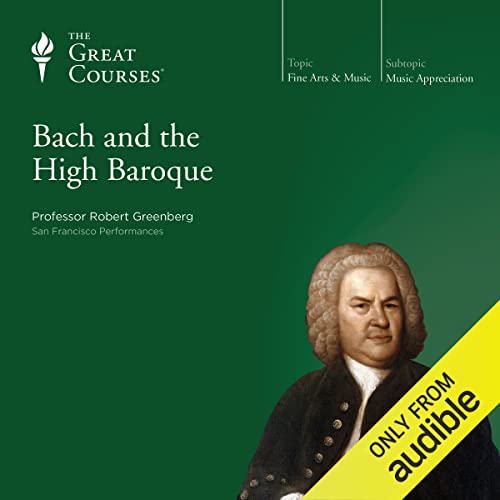
Bach and the High Baroque
Failed to add items
Add to Cart failed.
Add to Wish List failed.
Remove from wishlist failed.
Adding to library failed
Follow podcast failed
Unfollow podcast failed
Get 30 days of Standard free

Bach and the High Baroque
Buy for $30.39
Though unappreciated in his own time, Johann Sebastian Bach has ascended to Olympian heights, the verdict of contemporary audiences long since overruled by succeeding generations of music lovers. But what makes his music great? In this series of 32 lectures, a working composer and musicologist brings his exceptional teaching skills to the task of helping you hear the extraordinary sweep of Bach's music. You'll understand the compositional language that enabled him to compose such extravagant, unbridled music while still maintaining precise control of every aspect - beat, melody, melodic repetition, interaction, and harmony. Whether devoted admirer or casual listener, you'll gain a new appreciation of the composer and a heightened skill at listening to his work.
You begin by learning the musical traditions and composers that inspired Bach, and how he absorbed those influences to become the transcendent composer of the High Baroque, more representative of the period and its aesthetic of emotional extravagance and technical control than any other. And you'll learn how both his German Lutheran heritage and family background - at least 42 relatives professionally involved with music - helped shape him as an artist.
Above all, though, you experience an abundance of music, with Professor Greenberg highlighting his discussions by playing major excerpts from several of Bach's most important works - including the Brandenburg Concerto no. 2, the Goldberg Variations, and the Toccata and Fugue in D Minor - and also showing you how to compare Bach with other composers both before and after his time.
PLEASE NOTE: When you purchase this title, the accompanying reference material will be available in your Library section along with the audio.
©1995 The Teaching Company, LLC (P)1995 The Great Courses
Listeners also enjoyed...





Continue the series










People who viewed this also viewed...


Be that as it may, what I got out of these lectures far outweighs the stuff I missed. Professor Greenberg gives us a comprehensive understanding of the entire cultural sea change we call the Baroque, with special emphasis on the man whose music exemplifies that period. So, I understand what Baroque music evolved from, that Bach was the lucky inheritor of a newly established, rationalized, soon-to-be universal musical notation system, of new, highly perfected instruments, of a Lutheran theology that informed his music and gave that music a stage, both in and out of church. And much, much more. I even know how to pronounce Dietrich Buxtehude’s last name.
On top of that, Professor Greenberg is a joy to listen to. His intense love for his subject doesn’t preclude playfulness and humor – I got my title from one of his quips. Yeah, he’s a self-confessed secular humanist, but unlike many secular humanists, it doesn’t stand in the way of his appreciation of religious art. And his outline of the Reformation is about the best brief, even-handed explanation of that concatenation of theology, intellectual ferment, nascent nationalism, and power politics as I’ve ever come across.
The Bach-Meister
Something went wrong. Please try again in a few minutes.
If you have that background, this is really something for you. The courses are insprining and the narrator is enthusiastic about his topic, and he knows it very well. I advise you to listen one course at the time, then listen to some Bach music in between and then go on to the next course. If you try to take in all at the same time, it will be too much.
One thing that bugs me, however, is that professor Greenberg does not know how to pronounce Bach's name, at least not to a listener who like me speaks German. His consistent incorrect (=American) pronounciation ("Bock") could lead to the wrong conclusion that the good professor does not know what he is talking about. But he does and he is good at it, even though his German is deplorable (his Italian and French are possibly worse). A little language exercise: try to figure out who the composers "Wiwolde" and "Cooperand" are? (That is the way these baroque composers names are pronounced in this book).
So a really good course is tainted by bad language. However, if you can live with that, don't hesitate to buy this.
Understanding Bach
Something went wrong. Please try again in a few minutes.
Best ever
Something went wrong. Please try again in a few minutes.
Amazing
Something went wrong. Please try again in a few minutes.
rewarding
amazing
Something went wrong. Please try again in a few minutes.