


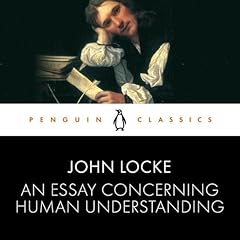
An Essay Concerning Human Understanding
Failed to add items
Sorry, we are unable to add the item because your shopping cart is already at capacity.
Add to Cart failed.
Please try again later
Add to Wish List failed.
Please try again later
Remove from wishlist failed.
Please try again later
Adding to library failed
Please try again
Follow podcast failed
Please try again
Unfollow podcast failed
Please try again
Get 30 days of Standard free
Auto-renews at $8.99/mo after 30-day trial. Cancel anytime

An Essay Concerning Human Understanding
Narrated by:
Leighton Pugh
Buy for $29.33
-
Narrated by:
-
Leighton Pugh
-
By:
-
John Locke
In these respects, one might think of Locke (1632-1704) as preparing the way for the 18th century, though An Essay Concerning Human Understanding dates from 1690. In the essay he remarks that he was ‘employed as an under-labourer in clearing the ground a little, and removing some of the rubbish that lies in the way to knowledge’. Everywhere, Locke’s 18th-century readers included learned philosophers, educators, historians and political thinkers but also local community and political leaders, students and many others eager to take advantage of the expanding world of print culture that was a central part of the Enlightenment.
Today, Locke remains an accessible author whose essay can still be listened to with pleasure by an engaged public around the world. Some will listen to his work to know more about the beginnings of the modern era; others will seek arguments to be used in present-day debates.
This recording presents An Essay unabridged. It is prefaced by an informative introduction (written for the Wordsworth Edition) by Mark G. Spencer, who explains: ‘The starting point for much of Locke’s philosophy was his keenness to explore how it was that humans arrived at their knowledge of the world. What do humans know? How do they know what they know?’ Or, as Locke himself puts it in his opening section, ‘Epistle to the Reader’, his purpose was to 'examine our own abilities, and see what objects our understandings were, or were not, fitted to deal with.’ And it remains an approachable text, for, as Spencer points out, Locke’s ‘intended reading audience was not one of scholars and philosophers shut up in their closets’ but the ordinary man.’
The essay is divided into four books: Part 1: Of Innate Notions, Of Ideas, Of Words; and Part 2: Of Knowledge and Probability.
Leighton Pugh reads with clarity and vigour.©2014 Public Domain, Introduction - Mark G. Spencer (P)2018 Ukemi Productions Ltd
Listeners also enjoyed...


adbl_web_anon_alc_button_suppression_t1
People who viewed this also viewed...



I must say, I truly enjoyed the content of this audiobook! Furthermore, my enjoyment was greatly enhanced by the professional quality of the recording done by Ukemi. My enjoyment was further enhanced by way of the excellent work in the reading of it by Leighton Pugh - great job Mr. Pugh!
Exhaustive Philosophic Treatise
Something went wrong. Please try again in a few minutes.
Performance was Good. Locke is no Hume.
Something went wrong. Please try again in a few minutes.
excellent epistemology
Something went wrong. Please try again in a few minutes.
Excellent Narration
Something went wrong. Please try again in a few minutes.
Informative and mind opening
Something went wrong. Please try again in a few minutes.