Business for Good Podcast Podcast Por Paul Shapiro arte de portada

Business for Good Podcast

Business for Good Podcast

De: Paul Shapiro
Escúchala gratis

Join host Paul Shapiro as he talks with some of the leading start-up entrepreneurs and titans of industry alike using their businesses to help solve the world's most pressing problems. Whether it's climate change, unsustainable agricultural practices, cyber threats, coral reef die-offs, nuclear waste storage, plastic pollution, or more, many of the world's greatest challenges are also exciting business opportunities. On this show, we feature business leaders who are marrying profit and purpose by inventing solutions to both build a better world and offer investors a bang for their bucks. Economía
Episodios
  • Hannah Ritchie Has Some Uncomfortable Truths About Helping the Planet
    May 15 2026
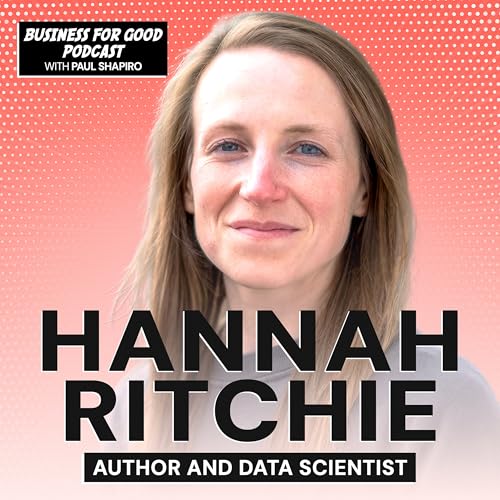
    What if the things you believe are best for the environment are actually making it worse? In this episode of Business For Good, Paul Shapiro sits down with Hannah Ritchie, data scientist at Our World in Data and author of Not the End of the World and Clearing the Air, to challenge some of the most widely held assumptions in sustainability. Hannah explains why locally produced food rarely has a meaningfully lower carbon footprint than imported alternatives, why organic farming often demands more land to produce the same amount of food, and why nuclear energy is one of the safest and most land-efficient power sources available. She walks through the data behind each of these claims and explains how well-intentioned environmental orthodoxies can actually slow progress toward the outcomes they aim to achieve. Things You Will Learn: Why buying local food does not significantly reduce your carbon footprint compared to choosing lower-impact foods from anywhere in the world. How the carbon footprint of keeping a dog compares to the average American's total annual emissions. Why nuclear energy has caused far fewer deaths per unit of electricity than fossil fuels over its entire history. Why cement production and air conditioning represent some of the most neglected opportunities for climate innovation. Tools & Frameworks Covered: Food Miles vs. Production Emissions: A data-driven framework showing that transportation accounts for roughly five percent of total food system emissions, while on-farm production and land use change dominate the footprint of most foods. Land Sparing vs. Land Sharing: Two competing approaches to balancing agricultural production with biodiversity conservation, where intensive farming on less land is weighed against lower-intensity farming spread across more land. Per-Unit Safety Comparison for Energy: A method of evaluating energy sources by calculating deaths per unit of electricity generated, which consistently shows nuclear and renewables are far safer than fossil fuels. #BusinessForGood #FutureOfFood #AlternativeProtein #SustainableBusiness
    Más Menos
    53 m
  • Why Jim Mellon Is Still All In on Alternative Protein After Five Years
    May 1 2026
    Episode Summary:

    Five years ago, billionaire investor Jim Mellon came on Business For Good and laid out his thesis that cultivated meat and precision fermentation would transform the food system. Since then, venture capital has fled the space, plant-based stocks have cratered, and many startups have gone under. So why is Jim putting even more money in?

    In this episode, Paul Shapiro reconnects with Jim Mellon, Author of Moo's Law and Chairman of Agronomics, to find out what has changed and what hasn't. Jim reveals that his portfolio company, Clean Food Group, is producing precision fermentation-based palm oil, olive oil, and cocoa butter at a factory near Liverpool that is already sold out to buyers, including Mondelēz. He shares how media costs for cultivated meat have dropped from nearly $1,000 per liter to under three cents, and why he expects the company to go public later this year in what could be the first IPO of a precision fermentation company.

    The conversation also covers why the Middle East may become the next major hub for alternative protein infrastructure, how robotics could improve agricultural yields and reduce food waste, and what Jim plans to change in the updated edition of Moo's Law. He also explains why, despite personal wealth, no single investor can fund the scale of infrastructure this industry requires.

    Things You Will Learn:

    1. How precision fermentation-based oils are already reaching price parity with conventional palm oil, olive oil, and cocoa butter.
    2. Why cultivated meat media costs have dropped from roughly $1,000 per liter to under three cents in just a few years.
    3. Why the Middle East could become the next major hub for alternative protein manufacturing.
    4. What Jim Mellon plans to change in the updated edition of Moo's Law.
    5. How robotics and AI could reduce crop waste and improve agricultural yields globally.

    Tools & Frameworks Covered:

    1. Moo's Law: The idea that the cost of producing cultivated animal products will decline on a curve similar to Moore's Law in computing, driven by advances in media formulation, facility design, and scale.
    2. Precision Fermentation for Commodity Oils: Using microbial fermentation to produce bio-identical palm oil, cocoa butter, and olive oil at competitive prices with greater supply consistency and without deforestation.
    3. Infrastructure-First Scaling: Building dedicated production facilities and securing offtake agreements before going to market, reducing capital carry costs, and proving commercial viability to attract institutional investment.

    #BusinessForGood #FutureOfFood #AlternativeProtein #SustainableBusiness

    Más Menos
    51 m
  • Investing in Biodiversity with Venture Capitalist Tom Quigley
    Apr 15 2026
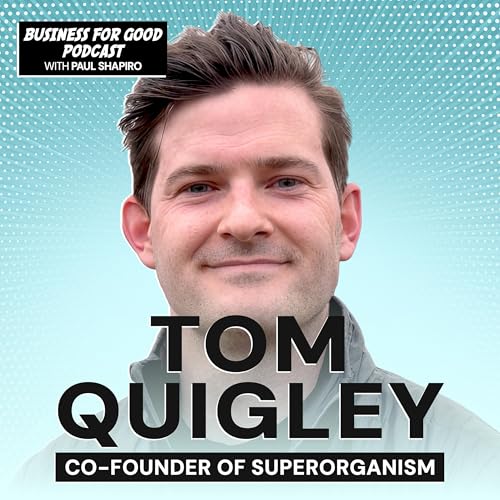
    Episode Summary: What if the next great venture opportunity isn't in AI or fintech but in protecting nature itself? In this episode of Business For Good, Paul Shapiro sits down with Tom Quigley, Co-founder of Superorganism, one of the first venture funds built entirely around biodiversity protection. With a freshly closed $26 million fund, Tom explains why over half of global GDP depends on healthy ecosystems, and why the degradation of those systems creates massive risk exposure for industries and supply chains worldwide. The conversation covers how biodiversity investing differs from climate tech, why cattle is among the most destructive forces for tropical ecosystems, and where venture-backed startups can intervene across areas like AI-powered wildlife monitoring, bird-safe glass, forest microbiome restoration, and silvopasture transitions. Things You Will Learn: Why over 55% of global GDP is moderately or heavily dependent on intact natural ecosystems. How biodiversity investing differs from climate tech and why it opens up categories like invasive species, bird-safe infrastructure, and soil restoration. Why cattle ranching is one of the most significant drivers of tropical biodiversity loss, hitting multiple vectors from deforestation to methane to runoff. How AI-powered camera systems are helping wind farm operators monitor and reduce bird strikes while defending against political opposition. Why bird-safe glass could prevent up to one to two billion bird deaths per year in the US alone, and what makes it an investable category. Tools & Frameworks Covered: Biodiversity Venture Thesis: A three-pillar investment framework targeting companies that disrupt industries driving biodiversity loss, operate at the overlap of climate and nature, or build enabling deep technologies for conservation. Dynamic Curtailment for Wind Farms: AI-powered camera systems that identify bird species near turbines and trigger slowdowns or shutdowns in real time to reduce strikes while maintaining energy output. Forest Microbiome Restoration: A soil treatment approach modeled on human gut microbiome transplants that restores mycorrhizal fungal networks in degraded lands to dramatically increase timber yield and ecosystem health. Silvopasture Transition: A land management strategy that integrates trees into cattle pastures, providing alternative revenue through forestry, native biodiversity plantings, and improved livestock performance through reduced heat stress. #BusinessForGood #FutureOfFood #AlternativeProtein #SustainableBusiness
    Más Menos
    56 m
adbl_web_anon_alc_button_suppression_c
Todavía no hay opiniones