

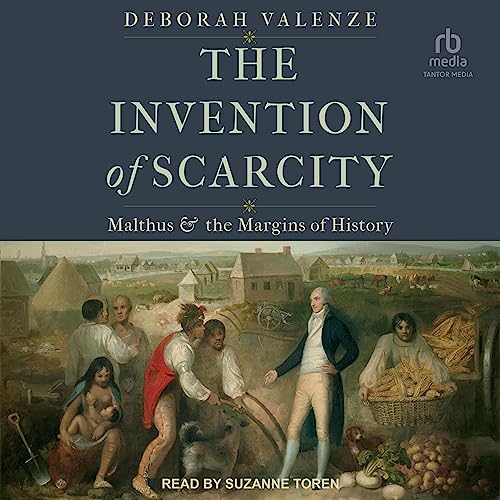
The Invention of Scarcity
Malthus and the Margins of History (Yale Agrarian Studies Series)
Failed to add items
Add to Cart failed.
Add to Wish List failed.
Remove from wishlist failed.
Adding to library failed
Follow podcast failed
Unfollow podcast failed
Get 3 months for $0.99/mo
 Prime members: New to Audible? Get 2 free audiobooks during trial.

The Invention of Scarcity
Buy for $17.49
-
Narrated by:
-
Suzanne Toren
-
By:
-
Deborah Valenze
With the publication of Essay on the Principle of Population and its projection of food shortages in the face of ballooning populations, British theorist Thomas Robert Malthus secured a leading role in modern political and economic thought. In this startling new interpretation, Deborah Valenze reveals how canonical readings of Malthus fail to acknowledge his narrow understanding of what constitutes food production.
Valenze returns to the eighteenth-century contexts that generated his arguments, showing how Malthus mobilized a redemptive narrative of British historical development and dismissed the ways that people adapted to the challenges of subsistence needs. She uses history, anthropology, and food studies to redirect our attention to the margins of Malthus's essay, where activities such as hunting and gathering were rendered extraneous. She demonstrates how Malthus's omissions and his subsequent canonization provided a rationale for colonial imposition of British agricultural models, regardless of environmental diversity.
By broadening our conception of human livelihoods, Valenze suggests pathways to resistance against the hegemony of Malthusian political economy. She invites us to imagine a world where monoculture is in retreat and the margins are recentered as spaces of experimentation, nimbleness, and human flourishing.
©2023 Deborah Valenze (P)2023 TantorListeners also enjoyed...


People who viewed this also viewed...



Very insightful!
Something went wrong. Please try again in a few minutes.