

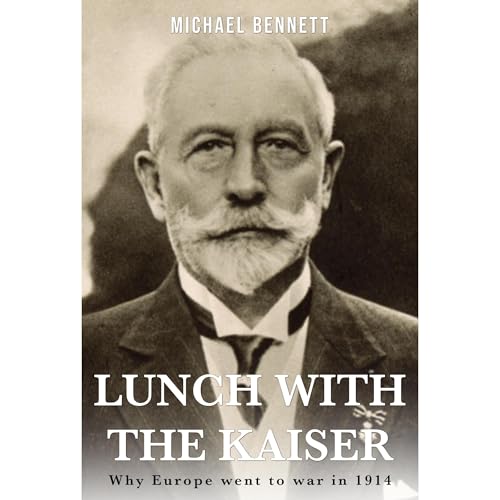
Lunch with the Kaiser
Why Europe went to war in 1914
No se pudo agregar al carrito
Solo puedes tener X títulos en el carrito para realizar el pago.
Add to Cart failed.
Por favor prueba de nuevo más tarde
Error al Agregar a Lista de Deseos.
Por favor prueba de nuevo más tarde
Error al eliminar de la lista de deseos.
Por favor prueba de nuevo más tarde
Error al añadir a tu biblioteca
Por favor intenta de nuevo
Error al seguir el podcast
Intenta nuevamente
Error al dejar de seguir el podcast
Intenta nuevamente
Obtén 30 días de Standard gratis
$8.99 al mes después de que termine la prueba. Cancela en cualquier momento

Lunch with the Kaiser
Narrado por:
Virtual Voice
Compra ahora por $5.99
-
Narrado por:
-
Virtual Voice
-
De:
-
Michael Bennett

Este título utiliza narración de voz virtual
Voz Virtual es una narración generada por computadora para audiolibros..
In London, a government nominally free of alliances and removed from the pressure for immediate mobilsation by the power of the Royal Navy, nevertheless rushed to war with what the British historian AJP Taylor termed 'indecent haste'. The political justification presented to the House of Commons, the strategic imperative of preventing a German hegemony in Europe, concealed the need to intervene to continue the appeasement of Russia due to Foreign Office policy miscalculations over Britain's imperial interests in Asia.
A series of fictional interviews, conducted with Kaiser Wilhelm II in October 1938 as he lived out his old age in exile, sets out the chronology of events revealing how Austrian recklessness, German miscalculation, Russian precipitation and French ambition, combined with British policy errors, led Europe to war. The book does not absolved Wilhelm from his share of responsibilty for the events of 1914 but places it in the context of decisions made by others who history has allowed to escape into undeserved obscurity.
adbl_web_anon_alc_button_suppression_t1
Todavía no hay opiniones