

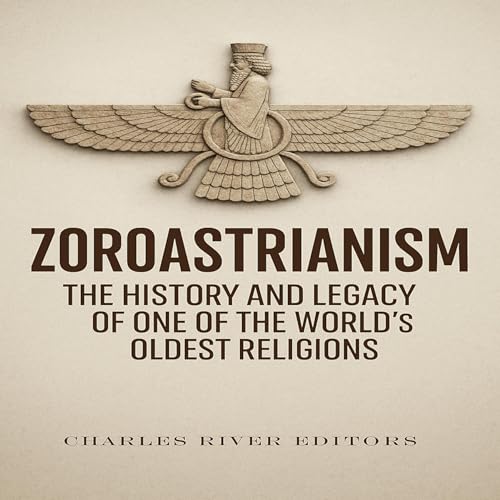
Zoroastrianism
The History and Legacy of One of the World’s Oldest Religions
Failed to add items
Add to Cart failed.
Add to Wish List failed.
Remove from wishlist failed.
Adding to library failed
Follow podcast failed
Unfollow podcast failed
Get 30 days of Standard free

Zoroastrianism
Buy for $10.63
-
Narrated by:
-
KC Wayman
During the first half of the 1st millennium CE, an empire arose in Persia that extended its power and influence to Mesopotamia in the east, Arabia in the south, the Caucasus Mountains in the north, and as far east as India. This empire, known alternatively as the Sasanian Empire or Sassanid Empire, was the last of three great dynasties in Persia—the Achaemenid and the Parthian being the first two dynasties—before the rise of Islam. In fact, many scholars consider the Sasanian Empire to be the last great empire of the ancient Near East because once it had been obliterated, Islam became the standard religion of the region, ushering in the Middle Ages.
The Sasanian Empire was important for a number of reasons. Besides being the last of three great Persian dynasties, they carried on many Persian cultural traditions relating to religion and kingship. The Sasanians fostered and promoted the native religion of Zoroastrianism to the point of persecuting other religions from time to time. It was during the Sasanian period that the numerous Zoroastrian hymns, prayers, and rituals were collected under one book, known as the Avesta.
Thanks to the Sasanians’ efforts with regard to religion, modern scholars know much more about Zoroastrianism than they would have if the religion continued to disseminate orally. Their efforts also protected Zoroastrian knowledge in later years after the dynasty was long gone and Islam became ascendant in Persia.
Moreover, the Sasanians’ spread into India meant that there were syncretic developments between Zoroastrianism and Indian mythology and religious practices, including not just Hinduism but also Sikhism, Jainism, and Buddhism. The diverse traditions and ethnic groups that have called India home over the past 5,000 years combined to create a mythology that is as eclectic as it is interesting. Unraveling the details of India’s mythological systems is no easy task.
Listeners also enjoyed...






People who viewed this also viewed...


