

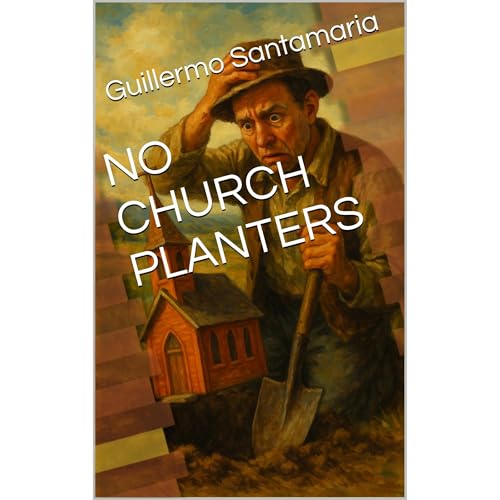
NO CHURCH PLANTERS
Failed to add items
Add to Cart failed.
Add to Wish List failed.
Remove from wishlist failed.
Adding to library failed
Follow podcast failed
Unfollow podcast failed
$0.00 for first 30 days

NO CHURCH PLANTERS
Buy for $3.99
-
Narrated by:
-
Virtual Voice

This title uses virtual voice narration
The piece argues that the modern “church planter” concept is a late, human-invented construct born out of 19th–20th-century missiology—the academic habit of systematizing mission work using theology plus social sciences—and especially out of recent evangelical church-growth culture. It sketches a brief history of missiology: mission in the NT and early church is simply narrated; medieval Catholicism talks about plantatio Ecclesiae as the church being planted in new lands; Protestant mission societies explode in the 18th–19th centuries; then figures like Warneck and Schmidlin turn “mission science” into a formal discipline, and 20th-century movements (Edinburgh 1910, missio Dei, liberation, contextualization, colonial critiques) make missiology a sprawling, contested academic field. Against that backdrop, the essay insists that “church planter” as a professional role is a very recent invention, not a biblical office.
On Paul and “planting,” the paper concedes that Paul does call himself one who “planted” and “laid the foundation” at Corinth (1 Cor 3), but stresses that these are agricultural/construction metaphors for his initial preaching of Christ in a place, not a job-title or a co-savior role. The Greek terms (φυτεύω, ποτίζω, αὐξάνω; θεμέλιον ἔθηκα / ἐποικοδομεῖ) all fit a simple sequence: Paul sows the gospel, Apollos waters with further teaching, and God alone gives growth; the Corinthians are “God’s field” and “God’s building,” and Paul hammers that the planter and waterer are “nothing” in comparison to God who causes life. Old School Baptists like Beebe and Trott, the essay argues, would gladly affirm that God uses men at the front end of a church’s history (Paul at Corinth, Beebe at New Vernon, etc.) but would violently reject the modern “church planter” model that turns that metaphor into a branded role. They would object that it smuggles in a man-God “partnership,” treats “church” as a product to be engineered by strategy, exalts the planter’s personality and metrics, and quietly moves from “God gathers churches” to “we plant churches.”
The last section traces how the language and machinery of “church planting” hardened into a technical system. Historically people spoke of “planting the church,” but not of a titled “church planter.” The essay shows that the actual noun “church planter” and its professional profile arise in late-20th-century evangelical missiology, especially through Charles Ridley’s research on “effective church planters.” Ridley’s 13 traits (visioning capacity, intrinsic motivation, relating to the unchurched, spousal cooperation, flexibility, resilience, etc.) became the backbone of the “Church Planter Profile,” which denominations and networks now use to screen, train, and invest in entrepreneurial planters. The essay’s verdict is that this profile is not a theological category but a psychological competency model, and it stands in sharp tension with Old School Baptist convictions that God alone saves and forms churches, while ministers are merely farmhands scattering seed God has already ordained to bring forth fruit.