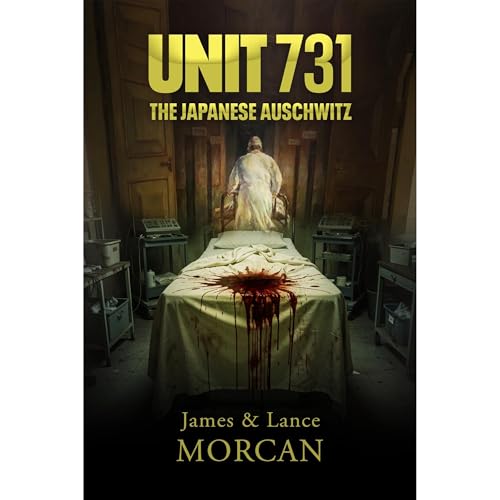
UNIT 731
The Japanese Auschwitz
Failed to add items
Add to Cart failed.
Add to Wish List failed.
Remove from wishlist failed.
Adding to library failed
Follow podcast failed
Unfollow podcast failed
Get 30 days of Standard free

UNIT 731
Buy for $3.99
-
Narrated by:
-
Virtual Voice

This title uses virtual voice narration
Unit 731: The Japanese Auschwitz (The Underground Knowledge Series Book 9) exposes one of the darkest and least acknowledged chapters of the 20th Century – a covert Japanese concentration camp disguised as a military complex in Northeast China during World War Two. A place where science, ambition, and cruelty fused into industrialized murder.
In the aftermath of that war, and indeed all wars before and since, few names evoke as much horror as Unit 731. Within its walls, prisoners were burnt, frozen, infected, dissected alive, and used as expendable test subjects in the pursuit of military supremacy. The atrocities committed within rivaled those of Nazi Germany’s most infamous concentration camps – hence this book’s subtitle: The Japanese Auschwitz.
Under the direction of mercurial, ambitious General Shirō Ishii inside Unit 731, a team of Japanese scientists, microbiologists, doctors, clerks and others developed a secret biological warfare program. In the process, they rationalized the systematic torture and murder of thousands of prisoners, or “monkeys” as they called them.
Drawing chilling parallels with Auschwitz, the authors reveal how Ishii and his cohorts became cogs in a machine of dehumanization, where killing was routine and paperwork masked genocide.
The collapse of Unit 731, the frantic cover‑up that followed, and the postwar silence – fueled in part by geopolitical deals that shielded perpetrators – underscore a moral failure that still reverberates today.
Perhaps the most shocking revelation is that postwar not one of Unit 731’s criminals was ever convicted for war crimes. Ishii and his fellow scientists traded the cutting edge biowarfare data they’d compiled for full immunity. The United States and their allies (especially the Soviets) were only too happy to oblige as they trailed the Japanese by a country mile when it came to understanding the complexities of biological warfare.
The sad reality is that General Ishii and his cohorts not only received full immunity but lived out their lives in relative peace, comfort and prosperity thanks to the Cold War politics of the era.
Comparisons between Unit 731 and Auschwitz remind us that brutality on a grand scale is not confined to one nation or one ideology. It materializes when science and medicine are divorced from ethics, when human beings are considered expendable, and when political expediency overrides morality and justice.
Unit 731: The Japanese Auschwitz reminds readers just how low humanity can sink.
Finally, a message from authors James & Lance Morcan: “Be warned, this book is not an easy read."
People who viewed this also viewed...