

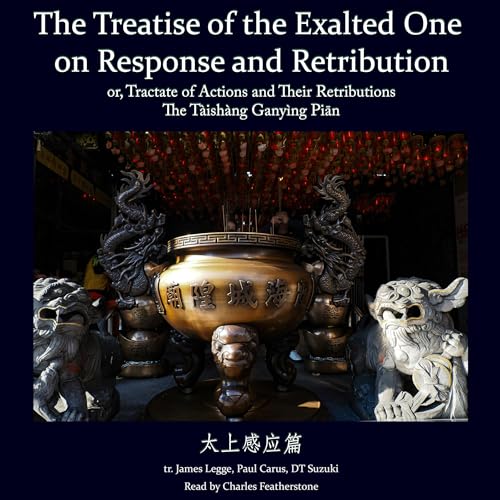
Treatise of the Exalted One on Response and Retribution
or Tractate of Actions and Their Retributions, Tàishàng Gǎnyìng Piān (太上感应篇)
Failed to add items
Sorry, we are unable to add the item because your shopping cart is already at capacity.
Add to Cart failed.
Please try again later
Add to Wish List failed.
Please try again later
Remove from wishlist failed.
Please try again later
Adding to library failed
Please try again
Follow podcast failed
Please try again
Unfollow podcast failed
Please try again
Get 30 days of Standard free
Auto-renews at $8.99/mo after 30-day trial. Cancel anytime

Treatise of the Exalted One on Response and Retribution
Narrated by:
Charles Featherstone
Buy for $10.63
-
Narrated by:
-
Charles Featherstone
By distilling the Dao to practical rules and simple stories, this book made complex ideas of Daoist retribution and self-cultivation accessible to all. It is one of the standout texts combining the "Three traditions" of Daoism, Buddhism and Confucianism into a single, livable whole.
It founded the literary tradition the of shànshū (善書) or "morality book," and bridges the divide between the abstract philosophy of the Dào and practical, everyday concerns.
Its opening lines set out its core premise—that blessings and punishments are not arbitrary but are drawn to a person by their own conduct, as inevitably as a shadow follows a form. To live a long and wealthy life, one must follow the rules that the spirits approve of.
Dating from the 12th century Song dynasty, the text was first brought to Western attention through the two translations included herein.
James Legge, the Oxford sinologist and populariser of Chinese classics, published it in 1891. Paul Carus, the German-American philosopher and pioneering populariser of Eastern thought, published his edition in 1906. This edition combines the two.
These translations introduced Chinese religious life to the English-speaking world. Legge viewed it as a key to understanding the evolution of Chinese ideas about retribution, while Carus presented it as a noble, popular system of ethics with universal appeal.
This is the book that for a thousand years defined what the good life was for the Chinese, and how to go about it. An essential read for anyone who wants to understand the traditional Chinese moral universe.
adbl_web_anon_alc_button_suppression_t1
No reviews yet