

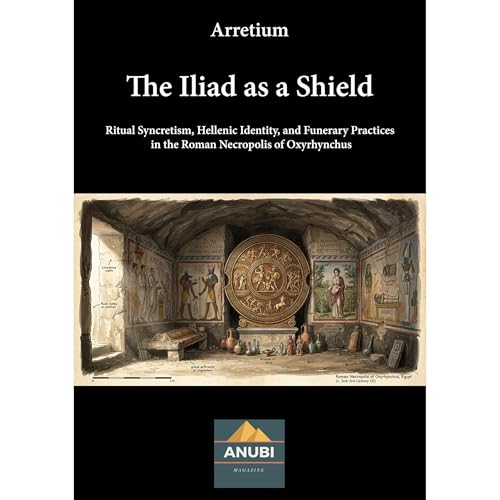
The Iliad as a Shield
Ritual Syncretism, Hellenic Identity, and Funerary Practices in the Roman Necropolis of Oxyrhynchus
Failed to add items
Add to Cart failed.
Add to Wish List failed.
Remove from wishlist failed.
Adding to library failed
Follow podcast failed
Unfollow podcast failed
Get 30 days of Standard free

The Iliad as a Shield
Buy for $5.99
-
Narrated by:
-
Virtual Voice
-
By:
-
Arretium

This title uses virtual voice narration
The city of Oxyrhynchus, identified with the modern site of El-Bahnasa in the Minya Governorate, is located approximately 190 kilometers south of Cairo along the Bahr Yussef, a branch of the Nile. During the Greco-Roman period, Oxyrhynchus played a role of extraordinary strategic and economic importance, establishing itself as the second city of Egypt after Alexandria, with which it maintained constant and fruitful commercial, institutional, and cultural exchanges. The international fame of the site among philologists and historians of antiquity dates back to the late 19th century, when in 1896 British archaeologists Bernard Grenfell and Arthur Hunt initiated systematic excavations in the city's rubbish mounds, bringing to light tens of thousands of papyrus fragments.These urban rubbish heaps turned into a natural archive unique in the world thanks to local climatic conditions, characterized by extreme aridity that preserved organic materials from the destructive action of humidity.
Although in the past papyrological research primarily focused on recovering administrative and literary documents from civil waste contexts, recent fieldwork has progressively shifted attention toward the monumental complexes of the necropolis. In this scenario, the Archaeological Mission of the University of Barcelona and the Institute of the Ancient Near East (IPOA) operates, a long-term project launched in 1992 under the direction of Josep Padró and currently led by co-directors Maite Mascort and Ester Pons Mellado, with Hassan Amer directing the excavations in the field.