

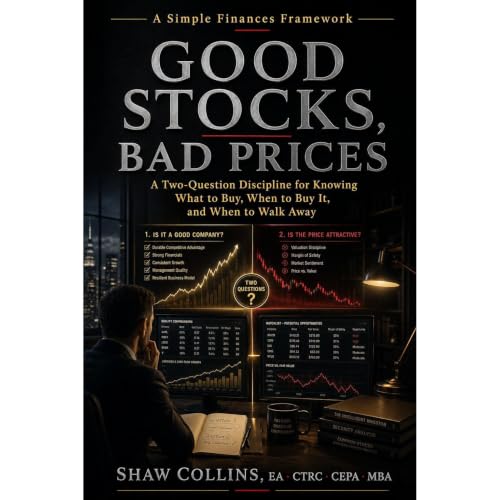
Good Stocks, Bad Prices
A Two-Question Discipline for Knowing What to Buy, When to Buy It, and When to Walk Away
Failed to add items
Add to Cart failed.
Add to Wish List failed.
Remove from wishlist failed.
Adding to library failed
Follow podcast failed
Unfollow podcast failed
Get 30 days of Standard free

Good Stocks, Bad Prices
Buy for $7.97
-
Narrated by:
-
Virtual Voice
-
By:
-
Shaw Collins

This title uses virtual voice narration
Most investors ask one question:
Is this a good stock?
That is not enough.
A great company can still be a terrible investment if you pay the wrong price. A cheap stock can still destroy capital if the business itself is broken. Good Stocks, Bad Prices is built around two questions:
Is it a good company?
Is this a good price, and is now the right time?
A buy requires a yes to both.
This book separates business quality from stock price and teaches investors to evaluate each independently before committing capital. Many investors lose money not because they chose bad companies, but because they bought good companies after the price had already run too far.
The opposite mistake is just as dangerous: buying a stock simply because it has fallen sharply without determining whether the decline created an opportunity or revealed a deteriorating business.
Good Stocks, Bad Prices creates a repeatable framework for avoiding both mistakes.
You will learn how to determine whether a company is genuinely worth owning by evaluating valuation, profitability, growth, and financial health. You will learn how to read margins, return on equity, revenue growth, debt, liquidity, and free cash flow without drowning in financial jargon.
You will also learn how to recognize a value trap: a stock that looks cheap because the underlying company is failing.
Once a company passes the quality test, the second question begins.
Is the price attractive?
The book explains how to identify strong companies that are temporarily out of favor rather than permanently broken. You will learn how to analyze drawdowns, the 200-day moving average, RSI, basing patterns, volume, accumulation, and the difference between a stock that has stopped falling and a falling knife that only looks cheap.
The framework produces four clear outcomes.
Buy means a good company at a good price with the decline stabilized.
Wait means a good company trading at a bad price.
Not Yet means a good company that is cheap but still falling.
Pass means a weak company, regardless of how inexpensive it appears.
The discipline is deliberately selective. Most stocks should not produce a buy decision. Patience is part of the system.
Inside, you will learn why a good company and a good stock are not the same thing, how to separate business quality from market price, how to detect value traps, why buying on good news often means buying too late, how to find healthy companies that are temporarily out of favor, how to recognize a real base, how to avoid catching a falling knife, how to define a buy zone, how to set a disciplined limit price, how to size a position, and how to decide when to sell.
You will also learn why every exit should be considered before emotion enters the trade, how to build a watchlist instead of forcing investment decisions, and why the ability to hold cash and do nothing may be one of an investor's greatest advantages.
The book integrates the Simple Finances Stock Analysis System and the Simple Finances When to Buy System. The book teaches the reasoning. The tools perform the analysis. Together, they create a disciplined workflow for deciding what to buy, when to buy it, how much to own, and when to walk away.
Good Stocks, Bad Prices is not about predicting the market or finding the next hot stock. It is about eliminating bad decisions.
The goal is not to buy more often.
The goal is to buy only when two things are true:
The company is worth owning.
And the price is worth paying.