

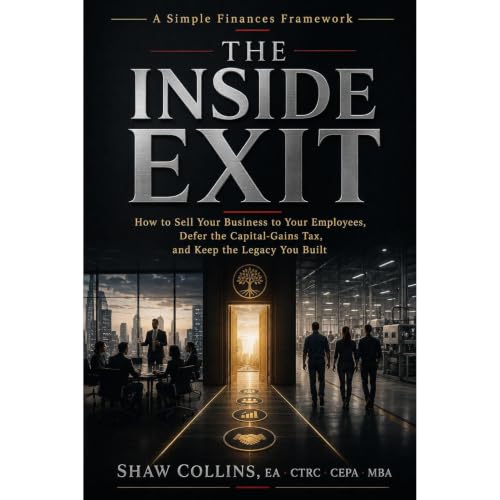
The Inside Exit
How to Sell Your Business to Your Employees, Defer the Capital-Gains Tax, and Keep the Legacy You Built
Failed to add items
Add to Cart failed.
Add to Wish List failed.
Remove from wishlist failed.
Adding to library failed
Follow podcast failed
Unfollow podcast failed
Get 30 days of Standard free

The Inside Exit
Buy for $7.97
-
Narrated by:
-
Virtual Voice
-
By:
-
Shaw Collins

This title uses virtual voice narration
What if the best buyer for your business is already inside it?
Most business owners believe they have only a few exit choices: sell to a competitor, sell to private equity, transfer the company to family, or simply keep working until they can no longer do it. But there is another path—one that may allow you to receive a fair price for your business, defer the capital-gains tax, protect the employees who helped build the company, and preserve the legacy you spent decades creating.
The Inside Exit explains how an Employee Stock Ownership Plan, or ESOP, can turn your own employees into the buyers of your business—without requiring them to write a check.
Written in clear, practical language, this book shows business owners how an ESOP actually works, who qualifies, where the money comes from, how the transaction is financed, and why the tax advantages can dramatically change the economics of a business sale. You will see how the selling owner may be able to use Section 1042 to defer the capital-gains tax, how the company can effectively finance its own purchase using tax-advantaged dollars, and why a fully employee-owned S corporation can operate with little or no federal income tax on the ESOP-owned portion of its earnings.
But this is not an ESOP sales pitch.
The Inside Exit also examines the risks, limitations, and situations in which an ESOP is the wrong answer. You will learn why company size, payroll, cash flow, management depth, valuation, debt capacity, and entity structure all matter. You will understand why an ESOP generally pays fair market value rather than a strategic premium, why sellers often do not receive all their cash on closing day, and how the long-term repurchase obligation can become a serious financial problem if it is ignored.
Inside, you will discover:
• Why the buyer you have been searching for may already work for you
• What an ESOP really is—and what it is not
• The five characteristics of a strong ESOP candidate
• How independent valuation determines what the ESOP can pay
• How Section 1042 may defer—and potentially eliminate—the capital-gains tax
• How the company can finance the acquisition using future cash flow
• Why ESOP financing can be significantly more tax-efficient than a conventional buyout
• How a 100% S-corporation ESOP can create an extraordinary long-term tax advantage
• How bank financing, seller notes, warrants, and staged sales can be combined
• Whether you really lose control after selling to an ESOP
• How to identify and plan for the repurchase obligation
• When an ESOP is absolutely the wrong exit strategy
• How to compare an ESOP with a strategic sale, private equity transaction, or family succession based on what you actually keep after tax
• How to complete a feasibility study before committing substantial money to the process
For the right company, an ESOP can accomplish something few other exit strategies can: transform the owner's business wealth into personal wealth while allowing the company to remain independent, protecting the workforce, creating employee ownership, and keeping the founder's legacy alive.
The highest headline offer is not always the best exit.
The right question is not simply, “Who will pay the most for my company?”
It is:
“Which exit leaves me with the best after-tax outcome, protects what I built, and creates the future I actually want?”
The Inside Exit gives you the framework to answer that question.