• Exhibit III: The Resurrectionist’s Rope
    Feb 18 2026

    Ah… this one carries weight.

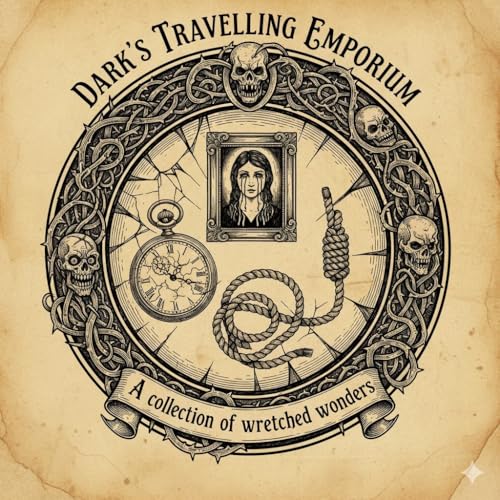
    This is Exhibit III: The Resurrectionist’s Rope — a length of coarse hemp once used by William Calcraft, London’s most notorious executioner. It appears simple. Functional. The sort of object history rarely pauses to look at closely.

    But this rope stood at the meeting point of two dark trades: those who stole the dead, and the man paid to create them.

    This exhibit explores public execution in nineteenth-century London, the blurred line between justice and spectacle, and the machinery that turned death into routine. It is not a story about guilt or innocence. It is about process. About repetition. About what happens when killing becomes administrative.

    Some objects remember hands. This one remembers necks.

    Step closer — but not too close.

    Show more Show less
    12 mins
  • S5 E3 The Crying Children – Nigeria’s Biafran War
    Feb 11 2026

    While the world was fixated on Vietnam and the Cold War, another catastrophe was unfolding almost unnoticed. Between 1967 and 1970, Nigeria descended into one of the most devastating conflicts of the 20th century — the Biafran War — where starvation was deliberately used as a weapon, and children became the frontline.

    In this harrowing episode of The Dark History Podcast, we uncover the full story of the Nigerian Civil War and the breakaway state of Biafra. From colonial borders drawn by the British, to ethnic violence, oil politics, and mass civilian death, this is the history behind one of the first modern, televised humanitarian disasters.

    You’ll hear how over 1–3 million people died, most of them civilians. How a total land, air, and sea blockade starved an entire population into submission. And how the world was forced to confront a new horror — kwashiorkor, the starvation disease that left children skeletal, bloated, and silent in front of international cameras.

    This episode explores:

    • The real causes of the Biafran War and Nigerian Civil War

    • The Igbo massacres and the birth of the Republic of Biafra

    • How starvation became an intentional military strategy

    • The role of Britain, the Soviet Union, and Cold War geopolitics

    • The origins of modern humanitarian aid and Doctors Without Borders

    • Why Biafra still matters today

    This is not a simplified war story. It’s a deep, immersive, and disturbing account of genocide, famine, colonial legacy, and moral failure — and a warning about how easily silence can kill.

    If you’re searching for dark history podcasts, forgotten wars, true history, or disturbing historical events, this episode is essential listening.

    Come closer to the fire — and prepare for one of the heaviest episodes we’ve ever made.

    🌐 Follow Dark History

    Facebook: https://www.facebook.com/darkhistorypod?mibextid=LQQJ4d

    Discord: https://discord.gg/3mHPd3xg

    TikTok: https://vm.tiktok.com/ZMLSvwJJV/

    YouTube: https://youtube.com/c/DarkHistory2021

    Twitter / X: @darkhistory2021

    Instagram: @dark_history21

    Email: darkhistory2021@outlook.com

    Show more Show less
    40 mins
  • Exhibit II: The Crying Boy
    Feb 4 2026

    Ah… yes. This one makes people uneasy.

    They expect something violent. Something obvious. They rarely expect a picture.

    This is Exhibit II — The Crying Boy.

    He once hung in ordinary homes. Passed without comment. Bought cheaply. Placed wherever there was space on the wall. Nothing about him seemed remarkable — until people began taking him down. Quietly, at first. Then urgently.

    This particular print was recovered after everything else in the room was gone.

    I won’t tell you why. I won’t tell you what was found — or what wasn’t.

    Only this: some objects don’t need to act. They only need to remain. To watch. To survive things they shouldn’t.

    Look at him if you must. Just don’t ask why his eyes are still wet.

    We’ll open the cabinet now.

    Support The Dark History Podcast

    Patreon (ad-free episodes & exclusive content): https://patreon.com/Darkhistory2021?utm_medium=clipboard_copy&utm_source=copyLink&utm_campaign=creatorshare_creator&utm_content=join_link

    Merch Store: https://www.teepublic.com/stores/dark-history?ref_id=36220

    Follow & Contact

    Facebook: https://www.facebook.com/darkhistorypod?mibextid=LQQJ4d

    Discord: https://discord.gg/3mHPd3xg

    TikTok: https://vm.tiktok.com/ZMLSvwJJV/

    YouTube: https://youtube.com/c/DarkHistory2021

    Twitter / X: @darkhistory2021

    Instagram: @dark_history21

    Email: darkhistory2021@outlook.com

    Show more Show less
    9 mins
  • S5 E2 The Glass Delusion: When People Believed Their Bodies Were Made of Glass
    Jan 28 2026

    For centuries, people across Europe were gripped by a terrifying belief: that their bodies were made of glass.

    In this episode of The Dark History Podcast, we uncover the forgotten psychological phenomenon known as The Glass Delusion — a historical mental illness that convinced kings, scholars, poets, and servants alike that a single touch could shatter them into pieces.

    From Charles VI of France, the king who ruled an empire while terrified of sitting down, to a learned scholar who believed he had transformed into a fragile glass vessel, this episode explores how fear, culture, medicine, and metaphor fused into one of the strangest mass delusions in recorded history.

    Set against the backdrop of the late Middle Ages, the Renaissance, and the Scientific Revolution, this story reveals:

    • Why glass became the ultimate symbol of human fragility

    • How early medicine failed those suffering from delusions

    • Why the Glass Delusion spread among intellectual and aristocratic circles

    • How cultural fears shape the way mental illness presents itself

    • And why this condition vanished almost entirely by the 18th century

    This isn’t just a strange historical curiosity. It’s a deeply human story about anxiety, identity, and what happens when the mind turns the body into a prison.

    If you’re fascinated by dark history, forgotten mental illnesses, historical psychology, medieval madness, and the unsettling ways culture influences fear — this episode is for you.

    🕯️ Support the Show

    Patreon (ad-free episodes & exclusive content): https://patreon.com/Darkhistory2021?utm_medium=clipboard_copy&utm_source=copyLink&utm_campaign=creatorshare_creator&utm_content=join_link

    Merch Store: https://www.teepublic.com/stores/dark-history?ref_id=36220

    🌐 Follow Dark History

    Facebook: https://www.facebook.com/darkhistorypod?mibextid=LQQJ4d

    Discord: https://discord.gg/3mHPd3xg

    TikTok: https://vm.tiktok.com/ZMLSvwJJV/

    YouTube: https://youtube.com/c/DarkHistory2021

    Twitter / X: @darkhistory2021

    Instagram: @dark_history21

    Email: darkhistory2021@outlook.com

    Show more Show less
    26 mins
  • Exhibit I: The Killer's Timepiece
    Jan 21 2026

    A cracked brass pocket watch. Its glass is shattered. Its hands are frozen at 3:47.

    This is Exhibit I of the collection — recovered from the body of Thomas Cutbush in Whitechapel, 1887. At first glance, it’s unremarkable. A cheap timepiece. A forgotten object. But this watch was not used to keep time. It was used to announce endings.

    In the gaslit streets of Victorian London, Cutbush approached women with the same ritual. He would ask the time. When they answered, he would show them his watch — its ticking loud in the silence — and tell them their time was nearly up. What followed was violence, measured not in minutes, but in obsession.

    This exhibit traces the short, brutal career of a man some later suspected as a precursor to Jack the Ripper — a figure hovering on the edge of that greater terror. It explores fixation, escalation, and the thin line between the forgotten attacker and the monster history remembers.

    The watch stopped during Cutbush’s final struggle, wrenched from motion as he was overpowered, its hands locked forever at the moment his violence ended. It has never been rewound.

    In this museum, time does not heal. It only remembers.

    *** Patreon link https://patreon.com/Darkhistory2021?utm_medium=clipboard_copy&utm_source=copyLink&utm_campaign=creatorshare_creator&utm_content=join_link ***

    Merch: https://www.teepublic.com/stores/dark-history?ref_id=36220

    Facebook: https://www.facebook.com/darkhistorypod?mibextid=LQQJ4d

    Discord https://discord.gg/3mHPd3xg

    Email: darkhistory2021@outlook.com

    Tiktok: https://vm.tiktok.com/ZMLSvwJJV/

    YouTube :https://youtube.com/c/DarkHistory2021

    Twitter: @darkhistory2021

    Instagram: @dark_history21

    Show more Show less
    12 mins
  • S5 E1 When the Clock Ran Out: The Last Men Killed in the Great War
    Jan 14 2026

    At 5:10 a.m. on November 11th, 1918, the First World War was officially over. But the killing didn’t stop.

    Six hours later, as clocks edged toward eleven, men were still being ordered forward. Shells were still falling. Machine guns were still firing. And across Europe, soldiers who had survived four years of industrial slaughter were killed in the final minutes — some seconds — before peace.

    In this episode of The Dark History Podcast, we narrow the lens to those last moments. We follow the final soldiers killed by Britain, France, the United States, Canada, and Germany — men who endured the entire war only to die when it no longer mattered. George Edwin Ellison. Augustin Trébuchon. Henry Gunther. George Lawrence Price. Names tied not to victory or defeat, but to timing.

    This isn’t a story about treaties or triumph. It’s about delay. Obedience. And a war that refused to end cleanly.

    Because when the guns finally fell silent, the world moved on — and left these men behind.

    *** Patreon link https://patreon.com/Darkhistory2021?utm_medium=clipboard_copy&utm_source=copyLink&utm_campaign=creatorshare_creator&utm_content=join_link ***

    Merch: https://www.teepublic.com/stores/dark-history?ref_id=36220

    Facebook: https://www.facebook.com/darkhistorypod?mibextid=LQQJ4d

    Discord https://discord.gg/3mHPd3xg

    Email: darkhistory2021@outlook.com

    Tiktok: https://vm.tiktok.com/ZMLSvwJJV/

    YouTube :https://youtube.com/c/DarkHistory2021

    Twitter: @darkhistory2021

    Instagram: @dark_history21

    Show more Show less
    33 mins
  • S4E24 Hearth & Home Horrors
    Dec 29 2025

    In this first-ever Hearth & Home Horrors, we step away from grand events and turn instead to the darker histories hidden in the places we grow up, walk through, and call home. These are the stories that don’t make national headlines — the ones carried quietly in local memory, passed down in families, spoken of in pubs, whispered across generations.

    In this special post-Christmas bonus episode, Rob shares three true tragedies rooted in three very different hometowns:

    • Wigan, UK (1908): A coal mine explosion that tore through the Maypole Colliery, killing 75 miners and boys, and leaving a permanent scar on a northern community built on hard labour and harder lives.

    • York, UK (1800s): The chilling story of Mary Bateman, the “Yorkshire Witch,” whose manipulation, fraud, and eventual murder of Rebecca Perigo reveal how fear and superstition can be twisted into something far more dangerous than folklore.

    • Portland, Maine, USA (1866): A firestorm that swept through the city on Independence Day, destroying nearly 2,000 buildings and leaving 10,000 people homeless — a disaster that forced Portland to rebuild itself from the ashes.

    These are small places with enormous shadows — ordinary towns shaped by extraordinary events. Stories from hearth, home, and the edges of memory.

    Settle in by the fire. Pour a drink. This is a bonus tale told between holidays, where the world slows down and history feels close enough to touch.

    Show more Show less
    16 mins
  • S4 E23 A Very Dark Christmas: True Tragedies from the Winter Shadows
    Dec 24 2025

    Christmas is a season wrapped in warmth, light, and nostalgia — but history doesn’t pause for the holidays. In this special episode of Dark History, we explore three true tragedies that unfolded in December’s deepest shadows.

    From the firestorm that tore Halifax apart in 1917, to the brutal Christmas Day massacre of the Lawson family in North Carolina, to the surrender of Hong Kong in 1941 — a moment that opened the door to one of the darkest chapters of the Second World War. These are not ghost stories or festive myths. They are real events, shaped by human fear, violence, and circumstance, all happening while the rest of the world sang carols and lit candles.

    This Christmas Special is a journey across continents and centuries, tracing the places where the season of light collided with the harshest edges of history.

    Settle in. Dim the room. Let the fire crackle. And step with me into the shadows.

    *** Patreon link https://patreon.com/Darkhistory2021?utm_medium=clipboard_copy&utm_source=copyLink&utm_campaign=creatorshare_creator&utm_content=join_link ***

    Merch: https://www.teepublic.com/stores/dark-history?ref_id=36220

    Facebook: https://www.facebook.com/darkhistorypod?mibextid=LQQJ4d

    Discord https://discord.gg/3mHPd3xg

    Email: darkhistory2021@outlook.com

    Tiktok: https://vm.tiktok.com/ZMLSvwJJV/

    YouTube :https://youtube.com/c/DarkHistory2021

    Twitter: @darkhistory2021

    Instagram: @dark_history21

    Show more Show less
    28 mins