Talking Kotlin Podcast Por Talking Kotlin arte de portada

Talking Kotlin

Talking Kotlin

De: Talking Kotlin
Escúchala gratis

A bimonthly podcast that covers the Kotlin programming language by JetBrains, as well as related technologies.Talking Kotlin
Episodios
  • How Major Metros Run on KMP
    Mar 5 2026

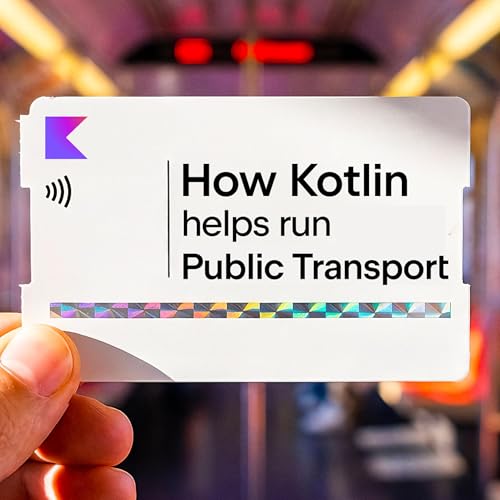
    Every time you tap through a subway gate in New York City, you’re using Kotlin Multiplatform! In this episode, we sit down with Paweł Kwieciński from Masabi to explore how they brought a decade-old Java codebase to KMP, powering ticket validation across mobile apps, embedded devices, and backend systems for public transit agencies worldwide.

    Resources:

    • Masabi
    • J2ObjC (Java to Objective-C translator)
    • Google Workspace Migration to Kotlin
    • Large Scale Changes with AI – Uber | Ty Smith
    • KotlinX DateTime
    • Ktor (Client & Server)
    • Burst library (archived)
    • Java ME (Micro Edition)
    • Mbed TLS
    • SQLDelight
    • Compose Multiplatform
    • JetBrains AI Assistant & Junie

    Hosts:

    • Sebastian Aigner – Website | Bluesky
    • Márton Braun – Website | Bluesky

    Guest:

    • Paweł Kwieciński

    Timeline:
    (0:00) Introduction
    (1:12) What is Masabi?
    (3:03) How does Kotlin fit into this?
    (6:30) System architecture overview
    (8:33) Embedded SDK and mobile apps
    (10:33) Ticket inspectors and validators
    (13:22) Offline operation
    (16:29) The KMP decision
    (24:42) Evaluating alternatives
    (27:21) Planning the migration
    (33:28) First lines of Kotlin
    (43:45) Translating Java to Kotlin
    (53:22) AI-assisted code translation
    (56:39) Early AI era challenges
    (1:05:01) Testing challenges
    (1:08:22) KMP dependencies
    (1:11:34) Domain-specific dependencies
    (1:16:55) Java ME and C interop
    (1:23:22) Backend-client sharing
    (1:26:59) Current status
    (1:31:48) Future plans: CMP
    (1:36:26) Wrap-up

    Más Menos
    1 h y 39 m
  • Kotlin 2.3 Release Special (Audio Exclusive)
    Feb 3 2026
    Sebastian and Márton host a special, audio-only episode where they discuss everything that’s new and noteworthy in the Kotlin 2.3 release. They touch on new language features like the unused return value checker and explicit backing fields, previously added features that became stable in this release, new APIs for time and UUID handling in the standard library, and improvements across all Kotlin platforms — from Native to Wasm and JS.Resources:What’s new in Kotlin 2.3KotlinConfGolden Kodee Community AwardsHosts: Sebastian Aigner – Website | Bluesky Márton Braun – Website | Bluesky Timeline:(0:00) Intro(1:13) Nested type aliases (stable)(1:46) Data-flow based exhaustiveness checks (stable)(3:28) Return statements in expression bodies(4:19) Unused return value checker (experimental)(12:57) Explicit backing fields (experimental)(18:51) Context-sensitive resolution (experimental)(20:11) Clock and Instant in the standard library (stable)(21:52) UUID v7 support and better parsing(26:14) Java 25 bytecode(26:36) Faster Native release builds(27:45) Swift Export: enums and varargs(29:08) C and Objective-C library import (beta)(30:49) Apple target support changes(32:15) Fully qualified names in Kotlin/Wasm(34:10) New exception handling for wasmWasi(35:32) Suspend function export to JS(37:51) LongArray export to JS(38:40) Unified companion object access in JS(41:05) @JsStatic inside interfaces(41:43) Default exports in JS(43:45) Compose stacktraces for minified Android apps(45:23) Breaking changes 🐜(46:14) Documentation updates(47:24) KotlinConf, Golden Kodees Awards(48:11) Wrap-up
    Más Menos
    50 m
  • Building AI Agents With Koog
    Nov 17 2025

    Sebastian and Márton talk to Vadim Briliantov, the Technical Lead for Koog: an agentic framework built by JetBrains. We learn about what AI agents are, and why building them in Kotlin with Koog is a great choice. We also discuss all the different ways AI agents can connect to other systems and your existing code, and look at advanced features for agents like custom strategies, model switching, and history compression.

    Resources:

    • JetBrains/koog on GitHub
    • Koog Documentation

    Hosts:

    • Sebastian Aigner – Website | Bluesky
    • Márton Braun – Website | Bluesky

    Guest:

    • Vadim Briliantov – LinkedIn | Medium | GitHub | Bluesky | Twitter/X

    Timeline:
    (0:00) Intro
    (1:11) Vadim’s history at JetBrains
    (4:21) What’s an AI Agent?
    (5:47) Koog!
    (7:12) Applications for agents
    (12:43) Koog’s building blocks
    (15:05) Strategies, feedback loops
    (23:55) The Kotlin DSL
    (26:12) Persistent state
    (29:48) Subgraphs
    (32:33) Tools
    (39:52) MCP support (and A2A)
    (44:01) Entry point and type safety
    (49:39) Spring and Ktor support
    (51:27) LLM Providers
    (53:30) Model switching
    (56:02) History and memory
    (59:22) Enterprise-ready
    (1:02:12) History compression
    (1:11:47) Markdown?!
    (1:14:37) What’s next?
    (1:18:22) Going open-source
    (1:20:32) Conclusion

    Más Menos
    1 h y 23 m
Todavía no hay opiniones