• Why are politicians swearing more and does it matter?
    Mar 31 2026

    Why do politicians swear—and why does it work?

    In this episode of UnSpun, DrSturg examines how profanity functions as a political tool. From viral moments like Biden’s hot mic comment abotu Peter Doocy to the Trump Access Hollywood tape and John Fetterman’s “jagoff” controversy, explore how vulgar language captures attention and, for some, signals authenticity.

    But there’s a trade-off.

    Research shows that while profanity can help mobilize supporters, for others it can also erode trust, deepen polarization and even divert attention away from substantive issues.

    Find out what happens when the system we're all a part of rewards what spreads instead of what informs?

    *****

    The episode starts with a logical fallacy, and DrSturg actually wrote a book about that where you can learn how to spot when newsmakers are using langauge to fool you with fun, real world examples. Find it here.

    And join the conversation on Bluesky!


    Advertising Inquiries: https://redcircle.com/brands

    Privacy & Opt-Out: https://redcircle.com/privacy
    Show more Show less
    23 mins
  • The Power of Local News in Fighting Misinformation: Journal Club Episode 5
    Mar 24 2026

    In this episode of UnSpun Journal Club, we break down new research on one of the biggest challenges in today’s information environment: misinformation.

    Most conversations focus on fact-checkers or national media. But this paper argues something different—that local journalism may be one of the most effective tools we have for stopping misinformation where it starts.

    We explore why misinformation spreads so effectively, why traditional responses often fall short, and what role local news might play moving forward.

    The question is not just whether local journalism works.

    It’s whether it will still exist when we need it.


    Advertising Inquiries: https://redcircle.com/brands

    Privacy & Opt-Out: https://redcircle.com/privacy
    Show more Show less
    17 mins
  • Baghdad Bob to AI War Propaganda: The First Story in a War Is Often Wrong
    Mar 17 2026

    In this episode of UnSpun, we examine how governments shape wartime narratives and how journalists have challenged them across modern history. From Baghdad Bob’s surreal press conferences during the 2003 invasion of Iraq to the Pentagon Papers, the My Lai massacre, and the Abu Ghraib scandal, the episode explores how independent reporting has exposed truths that official accounts initially concealed.

    We also examine how war reporting has evolved since World War II, including the rise of embedded journalism, the role of social media in modern conflicts, and the risks journalists face when reporting from the ground.

    As new conflicts unfold and accusations of misinformation intensify, understanding how war narratives are constructed has never been more important.

    Stay sharp.


    Advertising Inquiries: https://redcircle.com/brands

    Privacy & Opt-Out: https://redcircle.com/privacy
    Show more Show less
    32 mins
  • A quick video can slow the spread of fake news: Unspun Journal Club 4
    Mar 10 2026

    Can we stop misinformation before it spreads?

    In this episode of UnSpun Journal Club, I break down a real-world Instagram field study on “prebunking” — a strategy that teaches people to recognize manipulation tactics before they encounter viral misinformation.

    Instead of fact-checking after the damage is done, researchers tested whether a short 19-second video about emotional manipulation could strengthen people’s ability to detect misleading content in their feeds.

    The results? It did -- and the effect lasted five months.

    We explore:

    • How prebunking differs from debunking
    • Why misinformation spreads faster than fact checks
    • How this can help even with free speech concerns
    • How the audience can help each other


    It's not censorship. It’s ognitive defense.

    If you care about media literacy, journalism research, and practical strategies for navigating misinformation, this episode is for you.

    Find the full paper here: https://misinforeview.hks.harvard.edu/article/prebunking-misinformation-techniques-in-social-media-feeds-results-from-an-instagram-field-study/


    Advertising Inquiries: https://redcircle.com/brands

    Privacy & Opt-Out: https://redcircle.com/privacy
    Show more Show less
    15 mins
  • The anatomy of a scandal: Why the Epstein files don't just fade away
    Mar 3 2026

    Some scandals flare up, peak, and vanish. Others come back for years.

    In this episode of UnSpun, I trace the difference.

    Why was the Access Hollywood episode a brief burst, while h the Jeffrey Epstein case a story keeps returning in cycles, fed by court filings, testimony, and periodic document releases.

    Join me as I break down the structural forces that determine whether a scandal sticks.


    Advertising Inquiries: https://redcircle.com/brands

    Privacy & Opt-Out: https://redcircle.com/privacy
    Show more Show less
    33 mins
  • Deepfake videos make lies feel more true: UnSpun Journal Club 3
    Feb 24 2026

    Deepfakes don’t just tell you lies. They show you “proof.”

    In this episode of UnSpun Journal Club, I break downresearch from by Hwang, Ryu ad Jeong Cyberpsychology, Behavior, and Social Networking examining whether deepfake videos make misinformation more believable than text alone.

    The findings are concerning:


    But there’s good news. A short media literacy lesson—just seven minutes—helped a lot.

    I'll unpack:

    • Why video feels more like evidence
    • Whether media literacy education actually works
    • What this means for journalism, democracy, and everyday media consumers

    If you care about misinformation, media literacy, and how public perception is shaped, this episode is for you.

    Source:

    Hwang, Y., Ryu, J. Y., & Jeong, S.-H. (2021). Effects of Disinformation Using Deepfake: The Protective Effect of Media Literacy Education. Cyberpsychology, Behavior, and Social Networking. DOI: 10.1089/cyber.2020.0174


    Advertising Inquiries: https://redcircle.com/brands

    Privacy & Opt-Out: https://redcircle.com/privacy
    Show more Show less
    Not Yet Known
  • Are independent journalists doing a better job?
    Feb 17 2026

    Newsrooms are shrinking and experienced reporters are getting pushed onto Substack or into freelance work.

    Does it change the news you receive when journalism moves from institutions to individuals?

    In this episode of UnSpun, DrSturg looks at the complicated trade-offs that come with at the rise of freelance and independent journalism. From Washington Post layoffs to Substack newsletters, and from Don Lemon’s arrest to Nick Shirley's video about Minnesota daycares, we she considers how ethics, accountability, legal protection, and financial pressure change when journalists work alone.

    Independence can mean freedom, but it can also mean exposure.

    This episode breaks down research from multiple countries on how unstable working conditions shape the type of information produced — and what that means for you, as you get your news. .

    If you care about media literacy, press freedom, journalism ethics, misinformation, or the future of news, this conversation matters.

    Check out DrSturg's book, Detection Deception: Tools to fight fake news. Link takes you to independent bookstores, but the big guys have it, too. And find her on Bluesky and Instagram.

    Episode photo: by Bickanski on Pixnio


    Advertising Inquiries: https://redcircle.com/brands

    Privacy & Opt-Out: https://redcircle.com/privacy
    Show more Show less
    28 mins
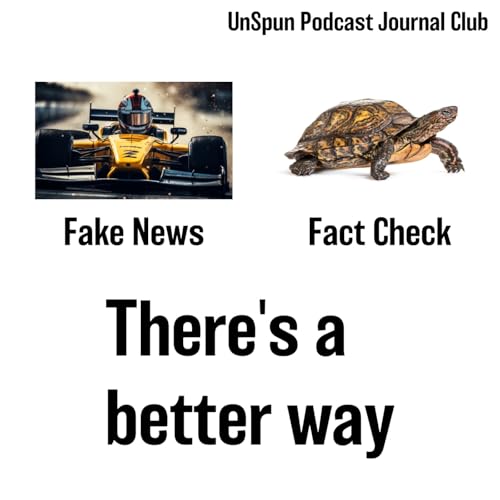
  • How social media markets reward fake news; UnSpun Journal Club 2
    Feb 10 2026

    Why don't fact checks stop fake news from spreading?

    In this episode of UnSpun Journal Club, I break down research by Carlos Diaz Ruiz from the Hanken School of Economics that argues disinformation spreads not just because people believe it, but because digital media markets reward it.

    We look at how attention turns into money. How platforms, advertisers, and influencers all benefit when content spreads fast—whether it’s true or not. From Macedonian fake news sites during the 2016 U.S. election to modern social media algorithms, this episode explains the problem when disinformation pays.

    We also explore the role of the First Amendment, global platforms like X, and why regulating misinformation is harder than it sounds—especially when U.S. tech companies operate across borders.

    Find Dr. Ruiz's paper here: https://journals.sagepub.com/doi/10.1177/14614448231207644


    Advertising Inquiries: https://redcircle.com/brands

    Privacy & Opt-Out: https://redcircle.com/privacy
    Show more Show less
    12 mins